 Skip to main content
Research Centre Meeting Highlights New Projects, Global Collaboration and More
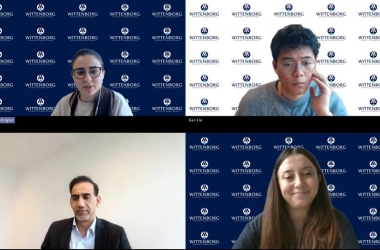
Aydan Holtrigter leads update on research, partnerships and upcoming opportunities
On 17 March, Wittenborg’s Research Centre hosted an online meeting, sharing updates on key projects, upcoming activities, and opportunities for both staff and students to get involved.
Opening the session, Aydan Holtrigter, Head of Research Partnerships and International Mobility, set the tone for a collaborative and forward-looking discussion.
Green4ADU: Building Green Skills for Adult Learners
One of the key highlights was the Erasmus+ funded Green4ADU project, now in its second year. The initiative focuses on upskilling low-skilled adults with green competences and preparing them for today’s labour market.
“We are in year two of the project, and the idea is to upskill low-skilled adults so they have the best knowledge available when it comes to green skills,” Holtrigter explained.
A major milestone has already been achieved with the launch of an online learning platform, featuring six self-paced modules available in multiple languages, including English, Dutch, Italian, Spanish, and Greek. Participants can complete the courses in their own time and receive certification upon completion.
The project is now moving into its next phase. In April 2026, new focus groups with educators will take place, followed by local workshops in May across partner countries, including the Netherlands, Germany, Italy, Spain, and Greece.
Holtrigter encouraged colleagues to get involved: “If you know people in your network who might benefit from these activities or the platform, we would be very happy to hear from you.”
Feedback from these activities will contribute to a final recommendations report for local authorities, ensuring the project delivers impact beyond academia.
TourXperience: Bringing VR into the Classroom
Another major initiative is the TourXperience project, a large-scale EU-funded collaboration focused on digital innovation in hospitality education.
“Our second project is in a completely different field, and we’re really excited about it,” Holtrigter shared. “It focuses on the digitalisation of hospitality education, especially the use of VR and XR tools in teaching.”
The four-year project involves 20 partners across 9 European countries.
In the coming months, the focus will be on training teachers to use VR and XR tools in education, including a Train-the-Trainer programme in Spain, as well as hosting international faculty from partner universities. Students will also have opportunities to participate in mobility exchanges in Greece and Spain.
“The idea is that once these VR tools and exercises are ready, our teachers can directly use them in their own classrooms,” Holtrigter explained.
AIDEA: Preparing Students for an AI-Driven Future
The Research Centre also introduced its newest project, AIDEA (Artificial Intelligence for a New Design Education Approach), which officially kicked off earlier this year.
The project focuses on integrating AI into design education and aligning teaching with rapidly changing industry needs.
“The idea is to train our students with the right knowledge about AI, so they are better prepared for the labour market and the disruptions AI is causing,” Holtrigter said.
Following a recent industry survey across five countries, the next step is a focus group on 30 April in Apeldoorn, bringing together faculty, students, and industry representatives. The session will also include a short AI workshop.
“This is just one of the first activities,” she added. “There will be many more opportunities for faculty to get involved.”
International Collaboration and Workshops
Through its Erasmus partnerships, the Research Centre continues to bring international expertise to Wittenborg.
In April, visiting professors from a partner university in Türkiye will deliver two workshops — one on information systems engineering and another on virtual reality in education. These sessions are expected to be offered in a hybrid format, making them accessible to a wider audience.
“If you are interested and available, these workshops are a great opportunity to learn new skills and connect with colleagues from abroad,” Holtrigter noted.
Looking Ahead
The Research Centre is also actively involved in developing new project proposals and strengthening its international network, with multiple submissions made in recent months.
Looking ahead, the coming period will be particularly active. “We have a pretty busy period from April to June, but every contribution from your side is very much appreciated,” Holtrigter said. She also noted that upcoming Research Centre meetings will be aligned with the academic calendar.
WUP 26/03/2026
by Erene Roux
©WUAS Press