 Skip to main content
Wittenborg Researchers Map How AI Can Support Student Learning

Where AI Meets Student-Centred Learning: New Study Identifies Six Core Components
Artificial intelligence (AI) is already part of university life. Students use it for research and feedback. Staff encounter it in learning platforms, assessment tools and analytics dashboards. The question is no longer whether AI belongs in higher education, but how it can be integrated in ways that genuinely strengthen student-centred learning rather than simply adding more technology to the classroom.
Researchers at Wittenborg, including Hind Albasry, Rauf Abdul and Dadi Chen, together with Estela Carmona-Cejudo of the Software Networks Research Group at i2CAT Foundation in Barcelona, Spain, set out to answer that question in a study published in Social Sciences & Humanities Open in 2025.
Using the Consensus App, an AI-powered academic search engine designed to find, organise and analyse peer-reviewed literature efficiently, the researchers conducted a systematic qualitative review of recent studies on AI in higher education.
The central research question guiding the study was clear: how can AI tools be effectively aligned with student-centred educational tasks in higher education?
Rather than developing a new AI tool, the researchers examined what already exists. They systematically searched and screened contemporary peer-reviewed studies on AI applications in higher education. Using a qualitative inductive approach, they analysed and coded the selected studies to identify recurring themes and practical patterns.
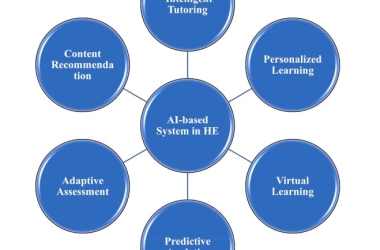
Albasry explained: “By systematically synthesising contemporary literature and employing a qualitative inductive method supported by an LLM-enhanced academic search engine, the study delivers a rigorously validated, holistic framework comprising six core AI-based components: intelligent tutoring, personalised learning, virtual learning environments, predictive analytics, adaptive assessment and content recommendation.”
Through this structured analysis, the researchers identified six distinct AI components that directly correspond to student-centred learning tasks. The study found that AI can meaningfully enhance learning when it is clearly mapped to pedagogical needs and grounded in educational principles.
Intelligent tutoring systems can provide ongoing, adaptive support tailored to individual progress. Personalised learning tools can adjust content and pace based on student performance. Predictive analytics can help identify students at risk and enable earlier intervention. Adaptive assessment can tailor evaluation to student ability. Content recommendation systems can improve access to relevant materials, while virtual learning environments can enhance interaction and engagement.
These findings are brought together in Figure 3 of the publication, which presents a comprehensive AI-based student-centred learning framework. The figure illustrates how each component plays a distinct yet interconnected role within higher education, offering practical guidance for institutions aiming to implement AI responsibly and strategically.
As Albasry noted, “It bridges a substantial gap by explicitly aligning AI capabilities with student-centred educational tasks, thereby offering a novel conceptual structure for curriculum designers, educators and technologists.”
For students, the framework highlights how AI can support more personalised feedback, clearer progress tracking and learning pathways that adapt to individual needs. For staff, it provides a structured way to evaluate AI tools not only in terms of efficiency but in relation to pedagogical value. Instead of adopting technology in isolation, the framework encourages educators to ask whether a tool enhances autonomy, inclusivity and meaningful learning.
The study also addresses ethical considerations and institutional readiness. Albasry emphasised the importance of responsible implementation: “I believe that AI must be approached not merely as a technological tool but as a strategic pedagogical partner. My work advocates for a responsible and student-centred integration of AI — one that enhances autonomy, equity and meaningful learning rather than replacing the educator’s role.”
She added, “By grounding AI applications in established educational principles and ethical considerations, we can ensure that technology uplifts diverse learners, empowers educators and strengthens academic integrity.”
Since its publication in 2025, the article has been made openly accessible through Elsevier’s Social Sciences & Humanities Open platform and indexed in research databases, increasing its international visibility and uptake.
The researchers also published another article in 2025, Revolutionising Higher Education: A Literature-Driven Exploration of AI-Based Student-Centred Learning Systems, in the Journal of Educational Technology Development and Exchange, further extending their work on AI-supported student-centred education.
WUP 20/04/2026
by Erene Roux
©WUAS Press