 Skip to main content
Wittenborg Hosts Professional Field Panel Meeting: Career Insights and Skills for Success
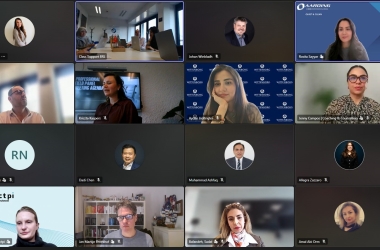
Rijn Platteel and Panel Explore Graduate Competences and Industry Trends
Wittenborg recently hosted its 2026 Professional Field Panel Meeting, bringing together faculty, business practitioners and alumni to discuss career development, industry trends and the skills students need to succeed in today’s global job market. The hybrid event welcomed participants both in Apeldoorn and online, reflecting Wittenborg’s international approach.
The session was chaired by Rijn Platteel, entrepreneur and Managing Director of VNO-NCW, who also serves as Chair of Wittenborg’s Advisory Board. Platteel opened the meeting by highlighting the urgency of connecting higher education with the needs of the workforce. “Change is not an enemy, stagnation is,” he said. “Keep developing, stay curious and build the bridges between imagination, innovation and impact.”
Alumni Insights and QS Stars Recognition
Kriszta Kaspers, Head of Education Development and Quality Management, emphasised the panel’s purpose: creating a space for reflective dialogue between Wittenborg, its alumni, and industry partners. She shared key findings from Wittenborg’s 2020–2024 alumni employability survey, covering more than 150 graduates across bachelor’s and master’s programmes.
The survey highlighted strong employment outcomes: 56% of graduates secured jobs immediately after graduation, 25% were already employed, and 8% had launched their own businesses. The average time to employment was just 2.36 months. Graduates mostly found roles in management, marketing, logistics, administration and sales, with smaller numbers entering IT, finance and HR.
Kaspers stressed the importance of collaboration with employers to overcome barriers such as visa requirements and Dutch language proficiency. Wittenborg is already addressing these with four intensive Dutch language weeks per year and by strengthening employer partnerships and practical career pathways. She also highlighted the institution’s global recognition, noting that in 2024 Wittenborg was rated five stars for employability by QS Stars — the highest possible accolade.
Career Path Presentations
The meeting featured three career path presentations from alumni and faculty, showing how Wittenborg prepares students for the real world:
Rosita Sayyar, MSc Digital Marketing and Communication, now Marketing Manager at Sequo Environmental, stressed the importance of combining technical knowledge with practical skills. “Companies don’t hire people just because they understand AI or digital marketing,” she said. “They hire people who can apply tools to improve decisions, processes and productivity.” Sayyar highlighted international teamwork, data analysis, presentation skills and real work experience, advising students to focus on actions they can take immediately to become employable.
Jan Martijn Broekhof, Wittenborg Lecturer, shared his journey as an entrepreneur and emphasised the human side of business. “Being decisive and reflective, and investing in human relationships, are key to long-term success,” he said. Broekhof encouraged students to enjoy the journey, embrace a sales mindset as a life skill, and remain agile in a fast-changing industry.
Muhammad Ashfaq, Professor of Applied Sciences at Wittenborg, outlined the latest industry trends, including AI, automation, decentralised finance, ESG investing and blockchain. He highlighted the importance of understanding these developments and praised Wittenborg’s international, diverse and ethical environment, which equips students with intercultural communication and ethical decision-making skills.
Preparing for the Age of AI
Panel discussions explored the gap between higher education and the skills industry will need in the next three to five years. Platteel observed: “AI is going to take over so much, so much actually more than we could possibly imagine. The only thing different from AI is that humans can imagine new things. We are about to enter the age of imagination, where humans alter reality and then feed that to AI.”
Sayyar added: “Students need to learn how to translate business problems into AI-assisted solutions, using AI for data analytics, automation and digital workflow, not just content generation. Responsible AI use means questioning the results and combining them with human expertise. Start by imagining new things yourself, then let AI do the groundwork. That human imagination is something AI cannot replicate.”
Further discussions emphasised that success in the modern workplace requires more than technical knowledge. Adaptability, curiosity, ethical awareness and cross-cultural communication were repeatedly highlighted, alongside practical experience and the ability to work effectively with AI tools. The panel reinforced Wittenborg’s role in preparing students with both the mindset and skills to thrive in a rapidly evolving global workforce.
WUP 20/03/2026
by Erene Roux
©WUAS Press