Skip to main content
Wittenborg Hosts Education Study Tour with Teacher Delegations from Korea
Strengthening International Exchange on AI and Digital Innovation in Education
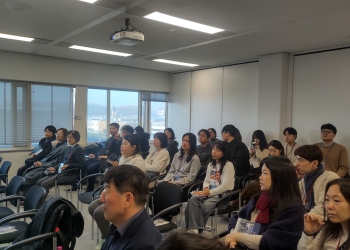
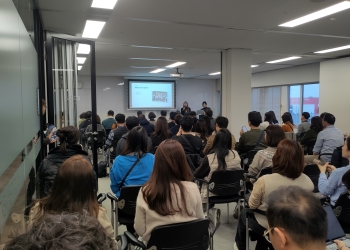
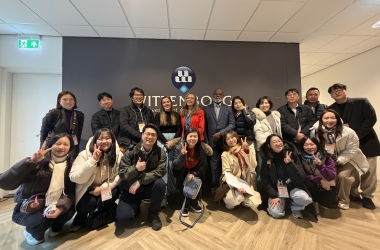
On 25 and 26 January, Wittenborg’s Amsterdam study location welcomed two delegations of middle school teachers from Daegu and Seoul, Korea, as part of an international study tour focused on the use of Artificial Intelligence (AI) and digital tools in the Dutch education system. More than 75 teachers, selected by the Metropolitan Office of Education under the Korean Ministry of Education, participated in the programme, organised by Amy Abdou, Senior Lecturer at Wittenborg.
Alongside lectures at Wittenborg, the delegations visited several secondary schools in Amsterdam to observe classroom practices and institutional approaches to digital innovation in education.
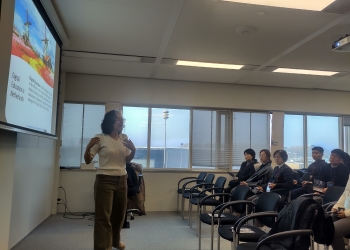
The first lecture was delivered by Hind Albasry, Associate Professor at Wittenborg. She outlined how AI can support personalised learning trajectories through adaptive scaffolding, particularly for students with learning difficulties. Using mathematics as an example, she explained how AI-based systems can diagnose recurring errors and respond with simpler exercises and additional explanations tailored to individual learners.
Albasry emphasised that students are particularly vulnerable users of digital technologies. Strong data protection frameworks, child-specific privacy safeguards and equitable access are therefore essential. She situated these considerations within the Dutch model of coordinated decentralisation in education governance, which aligns with the EU AI Act and the General Data Protection Regulation (GDPR).
She presented the Dutch digital education ecosystem as a multi-layered structure, spanning national policy and regulation, support organisations such as Kennisnet, procurement and vendor governance through SIVON and interoperability initiatives coordinated by SURF and EDU-V. At school level, implementation varies widely, reflecting differences in teacher competences, infrastructure and institutional readiness. Current developments include adaptive learning technologies, AI research pilots through the National Education Lab AI (NOLAI) and the formulation of national digital literacy learning outcomes.
The second lecture was given by Karcie Snoeijen, Project Lead Business and Innovation at NOLAI in Tilburg. She introduced NOLAI as a national innovation lab funded for ten years by the Dutch National Growth Fund to conduct applied research and pilot projects in educational AI. Since 2023, NOLAI has launched 26 projects in collaboration with universities, schools and educational technology companies, with early results published mid-2025.
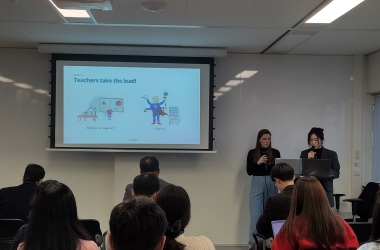
A defining feature of NOLAI’s approach is teacher-led co-creation. Educators formulate the research questions, participate in design and testing and validate prototypes in their own classrooms. This process brings together the different timeframes of research, schooling and industry within a protected experimental environment. Examples of projects include speech recognition for children reading in different dialects, AI-supported vocabulary learning in virtual reality, adaptive tools for students with developmental language disorders and AI-assisted support for reading instructions in pre-vocational education.
Snoeijen stressed the distinction between general purpose generative AI and educational AI designed specifically for teaching and learning. While young people make widespread use of AI, surveys indicate both high expectations and significant concerns regarding pupil dependency and teacher preparedness. NOLAI therefore advocates a hybrid, augmentation-oriented model in which teachers retain pedagogical authority and AI supports rather than replaces professional judgement.
Central to this vision is the concept of hybridity, combining human expertise with adaptive technologies, clearly defining which tasks can be automated and ensuring teachers maintain agency in shaping AI integration. Through initiatives such as the Teacher in Residence programme and alignment with European digital competence frameworks, NOLAI seeks to strengthen professional development, digital literacy and responsible innovation across the Dutch education system.