 Skip to main content
Student Research Explores the Ethical and Practical Impact of AI on Recruitment
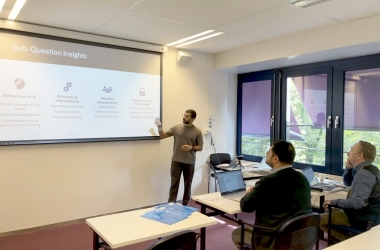
Study by Osama Karam Finds AI Increases Efficiency while Human Element Remains Crucial
As artificial intelligence (AI) continues to reshape industries globally, one of its most significant impacts can be seen in recruitment and human resources. From automated CV screening to predictive analytics, AI tools are redefining how organisations select and manage talent. For his graduation assignment, Wittenborg graduate Osama Karam decided to investigate how this technological transformation is influencing fairness, efficiency and the role of HR professionals in recruitment.
Osama, who completed his IBA in Economics & Management at Wittenborg’s Munich study location, the New European College (NEC), was driven by curiosity about the intersection of technology and human decision-making. “Many companies today are adopting AI tools to improve efficiency, reduce bias and make better hiring decisions,” he explained. “I wanted to understand how AI is impacting the role of HR professionals and how it influences the fairness and effectiveness of employee selection.”
For his research, Osama conducted interviews with eight HR professionals from four recruitment companies based in the Netherlands. The discussions covered various aspects of AI adoption in recruitment, such as its benefits, challenges, ethical implications and effects on workforce planning and employee engagement.
The findings reveal that AI has brought substantial improvements to recruitment processes. According to Osama, AI enhances efficiency, decision-making consistency, accuracy and candidate-role matching by automating repetitive tasks and reducing hiring time. “It also supports employee training and workforce planning,” he noted. However, his research also highlighted that human oversight remains crucial. “Human judgment is still essential to ensure fairness, assess soft skills, cultural fit and candidate drive, as well as manage ethical concerns like bias and data privacy,” Osama said.
Beyond the academic insights, the experience of writing his thesis proved deeply rewarding. “It was my first time conducting professional interviews,” he shared. “It was a great experience to interact with HR professionals, learn from their perspectives and see how AI is actually being used in recruitment.”
Reflecting on his journey, Osama described the process as both challenging and transformative. “I learned to overcome difficulties and realised how much I had grown academically and personally. Completing my thesis gave me a strong sense of achievement and confidence in my abilities. I’m grateful to my supervisor, Fahad Shakeel, for the continuous guidance and encouragement throughout the research process.”
Looking ahead, Osama intends to gain professional experience and pursue a master’s degree to deepen his academic and practical understanding. In the long term, he hopes to start his own business, applying the skills and insights he has acquired to build something impactful and innovative.
He advises current Wittenborg students working on their theses and graduation assignments to start early and choose a topic that truly interests and motivates them. “Stay consistent with your research, communicate regularly with your supervisor and follow their feedback carefully. Enjoy the process as much as you can and try to learn from it. It’s a great experience. You will look back at your achievement and feel proud of yourself, so make the most of the journey and stay positive always,” the graduate concludes.
WUP 01/05/2025
by Ulisses Sawczuk
©WUAS Press