 Skip to main content
Beyond the Product: Nikhil Chougule Challenges Students to Rethink Market Entry Strategy

Nikhil Chougule Shares Practical Lessons on Market Entry and Startup Growth
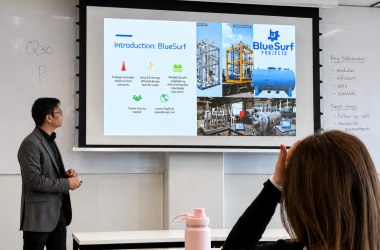
Wittenborg’s EBA students attended a guest lecture on 20 April at the Amsterdam study location, featuring entrepreneur and Wittenborg alumnus Nikhil Chougule, co-founder of Bluesurf Technologies.
Held at the Dali Building, the session focused on market entry strategy, market segmentation and business model development, offering students a practical perspective on how international businesses grow and compete.
Chougule, who has over a decade of experience in the industrial engineering sector, shared insights from building his company from its early stages in 2015 to expanding internationally, including the opening of a branch in Amsterdam in 2023.
Fall in Love with the Problem, Not the Product
A key message of the lecture was the importance of focusing on real customer problems rather than products themselves.
“Fall in love with the problem, not just the product,” Chougule told students, encouraging them to think beyond ideas and focus on real industrial needs.
He described entrepreneurship as a shift away from simply selling products towards solving meaningful challenges in specific markets.
Beachhead Strategy and Market Focus
Chougule introduced students to the “beachhead strategy”, explaining the importance of dominating a small, clearly defined niche before attempting to scale globally.
He emphasised that many businesses fail because they try to enter too many markets at once without establishing a strong foundation in one.
Another key concept discussed was “painkillers versus vitamins”, where he explained that successful businesses solve urgent problems rather than offering optional improvements.
“We look for industries where the cost of failure is high,” he said, pointing to sectors such as pharmaceuticals and oil and gas where precision and reliability are critical.
Active Discussion With Students
The lecture was highly interactive, with students asking detailed questions about capital management, market segmentation and international expansion.
Chougule highlighted the importance of making strategic choices early, particularly when entering complex global markets such as the Netherlands compared to larger markets like India.
“From our beginnings in 2015 to opening our Amsterdam branch in 2023, we learned that you must dominate a small niche before you try to conquer the world,” he said.
“The questions from the students on capital management and market segmentation were incredibly sharp,” he added. “It’s clear that the next generation of business leaders is ready to solve complex global challenges.”
Network Is Net Worth
Alongside strategy and market focus, Chougule stressed the importance of building professional relationships early in one’s career.
“Network is net worth,” he said, encouraging students to invest time in building meaningful industry connections before graduation.
He added that strong networks often play a decisive role in accessing opportunities, partnerships and long-term business growth.
Linking Theory to Practice
By the end of the session, students had gained insight into how strategic decisions shape business success long before a product reaches the market.
“Keep building, keep networking,” Chougule concluded.
Isaac Acheampong, Assistant Professor of Applied Sciences, said the lecture helped bridge the gap between theory and practice by showing students how market entry strategies work in real business environments.
“Traditional coursework often focuses on models and case studies, but practitioner-led sessions expose students to the realities behind strategic decisions,” he said. “Chougule demonstrated how the Uppsala Market Entry Model and the Beachhead Strategy can work together as practical tools for business growth.”
Acheampong added that the session encouraged students to think beyond theory and consider how startups manage risk, partnerships, compliance and resource allocation when entering new markets.
He also noted the strong level of engagement from students, particularly around questions on startup financing and whether these strategies could also apply to service-based businesses.
“Students were clearly thinking about the practical realities of entrepreneurship,” he said. “Their questions showed an interest not only in innovation, but in how businesses actually secure funding, build trust and scale sustainably.”
WUP 20/05/2026
by Erene Roux
©WUAS Press