Skip to main content
Walmart Ethics Spark Lively Student Debate at Wittenborg
Students Put Walmart’s Social Value on Trial during Intercollegiate Debate in Amsterdam
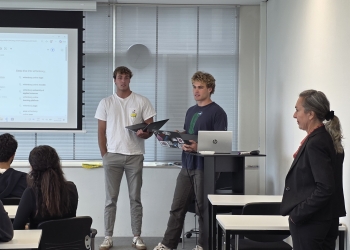
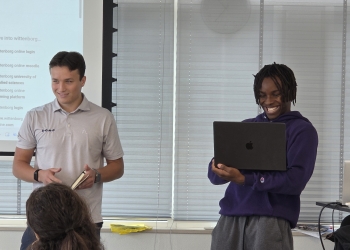
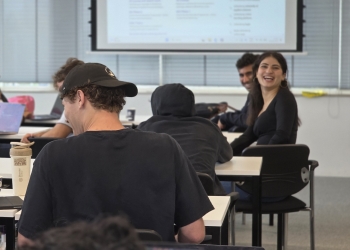
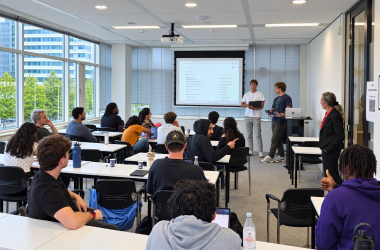
Students from Wittenborg and the IES study abroad programme recently came together in Amsterdam, for a lively intercollegiate debate on the ethics and social value of Walmart.
Founded by Sam Walton in the United States in 1962, Walmart grew from a single discount store into one of the world’s largest retailers. The Walton family continues to hold a significant stake in the publicly traded company, making Walmart an interesting case for examining family business, corporate governance and social responsibility.
Organised by Wittenborg’s Amy Abdou, the debate started with students presenting different perspectives on the retailer. They explored Walmart’s development as a family business, its strengths and weaknesses and criticism surrounding its low-price business model and social impact.
Then it was time to choose sides.
Students were split into two teams, with one arguing that Walmart creates social value and the other making the case that it does not. Abdou encouraged students to challenge themselves by considering a position they might not normally take. And the debate quickly came alive.
Students defending Walmart argued that its low prices benefit consumers, particularly lower-income households, while its size creates jobs and opportunities for employees to move into management.
On the other side, students questioned what those low prices mean for workers, suppliers and smaller businesses. They challenged Walmart’s impact on local communities and raised questions about wages, employee benefits and supply chains.
Challenging the arguments
As the discussion gathered pace, students did more than deliver prepared points. They challenged statistics, questioned sources and responded directly to each other.
A discussion about the effect of Walmart stores on local businesses, for example, prompted competing arguments about jobs and consumer savings. When sourcing came up, students began examining precisely what it means for products to be “made”, “grown”, “assembled” or “sourced” in a particular country.
The conversation soon moved beyond Walmart itself. Students debated wages, healthcare, competition and the respective responsibilities of businesses and governments. They also explored whether complying with the law is enough for a company to be considered socially responsible.
One student argued that social responsibility meant stepping back from what is legally required and considering “what’s morally right”.
More than an academic exercise
For Abdou, that exchange of ideas is an important part of the format.
She regularly organises intercollegiate debates around recognisable companies and industries. Previous discussions have covered Spotify and music rights, as well as Tony’s Chocolonely and ethics in the cocoa industry.
Abdou has noticed that students particularly enjoy the social aspect of the debates, which was something hoped the format would encourage.
That social element continued after the final arguments, when Wittenborg and IES students sat down for lunch together.
WUP 05/10/2026
by Erene Roux
©WUAS Press