Skip to main content

Inside Wittenborg's First International Staff Week
International Staff Week, Globalisation Forum and Project Week Combined for a Week of International Exchange
From artificial intelligence and educational innovation to new opportunities for Erasmus+ cooperation, Wittenborg's first International Staff Week brought international partners to Apeldoorn for a week of knowledge exchange, professional development and collaboration.
Held alongside the Globalisation Forum 2026 and Wittenborg's October Project Week, the initiative welcomed almost 20 Erasmus+ participants representing eight partner higher education institutions across Italy, Poland, Georgia, Jordan, Tunisia and Egypt.
For Aydan Holtrigter, Head of Research Partnerships and International Mobility, combining the two initiatives marked an important milestone.
"Combining the Globalisation Forum with International Staff Week was a very natural step for us. The Forum gave our partners a space to engage in academic discussion, while the Staff Week allowed us to take those conversations further and explore mobility, joint projects, research cooperation and other concrete opportunities. It turned a two-day event into a full week of international exchange."
Bringing Partners Together
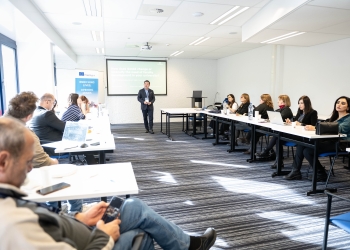
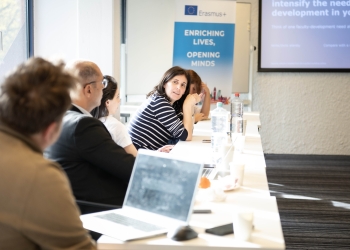
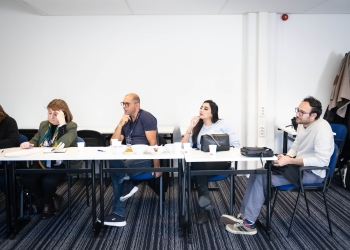
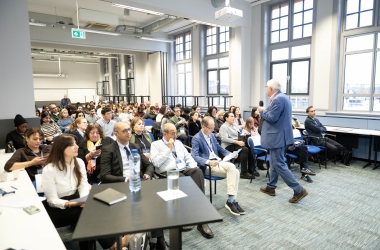
Throughout the week, participants joined workshops, panel discussions and networking sessions while exploring ideas for future cooperation between institutions.
For many, the greatest value came from building new connections.
Ana Pochkhua of European University in Georgia described the network she built throughout the week as her biggest takeaway.
"The network that I met here was the biggest thing for me," she said. "There are many ways we can cooperate through student exchanges, staff exchanges, administrative staff exchanges and projects."
Similar views were shared by Tariq Al-Azab of Al-Balqa Applied University in Jordan.
"We have new contacts," he said. "We know how we can cooperate together in the future through Erasmus+."
Beyond Student Mobility
While mobility remains an important part of international cooperation, participants repeatedly spoke about moving beyond exchanges towards longer-term collaboration.
Tamara Mechurchlishvili of Georgian American University highlighted opportunities for deeper partnerships between institutions.
"Exchange programmes are just the first step," she said. "The next step can be bigger projects, common research and professor exchange."
She also pointed to the similarities between Wittenborg and her own institution.
"I feel here like at home," she said. "Georgian American University is the most international university in Georgia, and Wittenborg is also one of the most international institutions in the Netherlands. This multicultural environment is very important to us."
Mohamed Ahmed Afifi of Nile University in Egypt also identified opportunities to deepen cooperation beyond existing mobility activities.
"We started with Mobility KA171 and we can expand this further, not just through staff and student mobility, but through Erasmus+ capacity-building projects, research collaboration and partnership."
Sharing Ideas and Good Practices
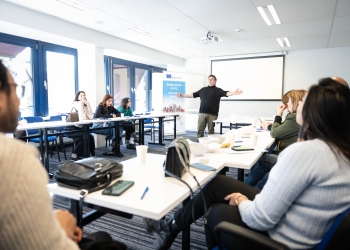
The programme included workshops on strategic faculty development, artificial intelligence, assessment and educational innovation, alongside sessions connected to Erasmus+ projects such as Green4ADU and TourXpeRience.
For Afifi, discussions around AI and its impact on higher education were among the most valuable aspects of the week.
He also underscored the TourXpeRience VR session as a particular highlight, noting its potential to support teaching and learning where laboratory resources and physical space may be limited.
Sandra Haddad of Egypt's Arab Academy for Science, Technology and Maritime Transport said the week demonstrated the wider value of international cooperation.
"Tolerance, acceptance and internationalisation are the real solutions to understanding each other, working together and eventually building tomorrow's leaders," she said.
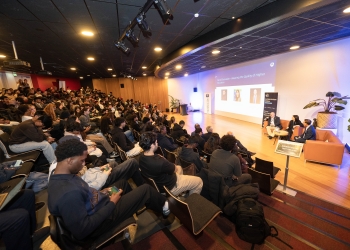
Haddad also praised the Forum discussions, which explored AI, innovative teaching methods, internationalisation and the future direction of higher education.
A New Annual Initiative
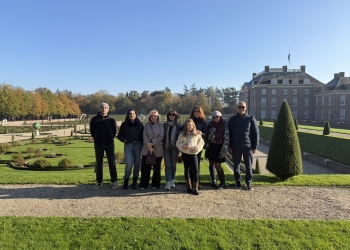
Alongside the academic programme, participants concluded the week with a cultural visit and lunch at Paleis Het Loo.
According to Holtrigter, the positive inaugural edition has already confirmed its own future.
"The real value comes from bringing people into the same room. We often work with our partners through Erasmus+, research projects or bilateral cooperation, but meeting in person creates a different level of exchange. People start discussing ideas, identifying shared challenges and finding opportunities for collaboration that may not emerge through formal communication alone."
Following this success, International Staff Week will become an annual part of Wittenborg's Globalisation Forum programme, with the next edition scheduled for the week of 1 November 2027.
WUP 20/11/026
by Erene Roux
©WUAS Press